
How to Search Oceana County Traffic Court Records
The main way to look up an Oceana County traffic case online is MiCOURT Case Search, the Michigan judiciary's statewide public case search. Traffic and civil-infraction cases in the county are filed with the 79th District Court, and that court is the tenant you select inside MiCOURT. The county links the same tool from its district court page as a public case search for informational use. Depending on the court searched, the system may return traffic, civil, misdemeanor, and other case types.
A second public tool is the 79th District Court Court Display docket, which lists the hearings set for a given day. It is a calendar, not a full case file. Before starting either search, gather the citation number from the ticket, the driver's full name, and the date of the stop. A license number and date of birth help narrow common names, though date-of-birth searching is treated as a secured feature rather than the basic public view.
- Open MiCOURT Case Search and choose the 79th District Court as the court to search.
- Enter the driver's name or the citation and case number printed on the ticket.
- Add the offense date or a short date range to narrow a common name to the right case.
- Open the matching case to read the charge, hearing schedule, responsibility finding, and balance.
- Use the district court clerk or the Court Display docket for hearing details the portal does not show.
Note: Michigan limits public web-portal access to case numbers, party names, and the register of actions, so the full ticket document may still require a clerk visit.
Which Court Handles Traffic Cases in Oceana County
Every traffic and civil-infraction case in Oceana County is heard by the 79th District Court in Hart. The county website files the court under a "78th-district-court" web address, but the court itself, MiCOURT, and the state e-filing system all identify it as the 79th District Court. It is a limited-jurisdiction trial court with one elected judge, Hon. John Middlebrook, and a court administrator and magistrate, Adriana Facundo, who presides over most informal traffic hearings.
The court's Traffic Division handles citations, payments, and hearing requests, with Deputy Clerk Amanda Luttrell listed for traffic matters. Beyond traffic, the same court manages small claims, landlord-tenant cases, misdemeanors, arraignments, and preliminary examinations, so a traffic file sits alongside the county's other district-court records.
100 S. State Street, Suite L-15
P.O. Box 471
Hart, MI 49420
Phone: (231) 873-4530
Hours: Monday to Friday, 8:00 a.m. to 5:00 p.m.
Types of Oceana County Traffic Cases on Record
Most tickets are civil infractions, not crimes. A civil infraction is decided by whether the driver is responsible, and it carries a fine, costs, and points rather than a jail sentence. A smaller share of driving cases are misdemeanors that route through the same court but follow criminal procedure. The record type depends on the charge on the ticket.
- Moving violations - speeding, disobeying a stop sign or signal, failure to yield, and careless driving.
- Non-moving and equipment - improper parking, expired plates, improper plates, and similar infractions.
- Construction and work-zone - higher fines and points for speeding through a posted zone.
- Limited-access highway - freeway speeding, scored on a separate point scale.
- Commercial vehicle - citations tied to a commercial driver's license and reported to the state.
- Misdemeanor traffic - driving while license suspended, reckless driving, and impaired-driving charges.
What Oceana County Traffic Court Records Show
A traffic case file records the ticket, the court steps that follow, and the outcome. The public view usually shows the case-level detail rather than scanned documents. The fields below track a citation from the roadside stop to the finding that closes it.
- Citation and case number
- The ticket number and the district court case number assigned when the citation is filed.
- Offense and statute
- The violation charged and the Michigan Vehicle Code or local ordinance section it falls under.
- Officer and agency
- The citing officer and the law-enforcement agency that issued the ticket.
- Hearing type
- Whether the case is set for informal hearing, formal hearing, or a payment deadline.
- Responsibility finding
- Responsible, not responsible, or admitted, entered after payment, hearing, or default.
- Fine and costs
- The amount owed, including statutory costs and any late charges.
- Points
- Points assigned to the offense, which the court reports to the Secretary of State.
- Default and payment
- Whether a default entered for nonpayment and the current balance or paid status.
Searching by Citation Number or by Name
A citation or case number is the fastest way to reach one exact record. A name search casts wider and can return several people who share the same name, so an offense date or middle initial helps confirm the match. MiCOURT runs as a dynamic application, and its exact fields shift, but the public interface and the court API confirm the search inputs below for Oceana courts.
| Search Field | Type | Required | Notes / Format |
|---|---|---|---|
| Court | Search / dropdown | Yes | Select 79th District Court for Oceana County traffic cases. |
| Case Search | Tab / page | Yes | Public case-search interface for name or case number. |
| Date of Birth | Date | Conditional | Treated as a secured search feature, not the basic public view. |
| hCaptcha | Verification | Conditional | Bot check may appear before results load. |
| Login | Secured route | Conditional | Some access uses a court login for expanded search. |
Note: A traffic case that predates online indexing, or one that is sealed or nonpublic, may not surface in MiCOURT even when the court holds a paper file.
Paying or Contesting an Oceana County Traffic Ticket
A driver can admit responsibility and pay, or deny responsibility and ask for a hearing. Paying within 14 days of the offense date keeps the amount at the listed fine and costs. The county links a secure payment portal from the district court page, and the court also takes payment in person and by mail. Cash, check, money order, and credit or debit cards are accepted, with a 3.5 percent fee added on card payments.
To contest a ticket, the driver requests a hearing instead of paying. An informal hearing needs no attorney and is heard by the magistrate, while a formal hearing follows stricter trial rules. Either way, the request must reach the Traffic Division before the deadline on the ticket.
- Read the citation and confirm the case belongs to the 79th District Court in Oceana County.
- To pay within 14 days, use the county online payment link or contact the Traffic Division for the exact amount.
- To contest, request the hearing type you want before the deadline printed on the ticket.
- Gather witnesses and documents, and attend on the scheduled date, since no adjournment is allowed within seven days.
- If found responsible, pay the fine and costs, then check your state driving record for any point effect.
Informal Hearings Before a Magistrate
An informal hearing decides only whether the driver is responsible for the infraction. The magistrate usually presides instead of the district judge. Neither side may bring an attorney, and there is no jury and no court reporter. The magistrate weighs the evidence by a preponderance standard, which the county describes as 51 to 49 percent, rather than proof beyond a reasonable doubt. Intent does not decide the outcome.
The driver may testify, bring witnesses, and question the officer or other witnesses. One adjournment from the first hearing date is allowed, but none within seven days of the scheduled date. The magistrate cannot reduce or waive the points tied to an offense, so a responsible finding carries the full point value to the state.
Pay in full at the hearing. If the magistrate finds the driver responsible, all fines and costs are due immediately under Michigan Court Rule 1.110. A driver who does not want to proceed must pay all fines and costs at least 24 hours before the court date.
Oceana County Traffic Fine and Point Schedule
The 79th District Court publishes a traffic fine schedule that pairs common violations with their fine, costs, and point value. The listed amounts apply to payments received within 14 days of the offense date. Not every offense appears on the list, and the Traffic Division confirms the amount for anything not shown.
| Offense | Fine / Cost | Points |
|---|---|---|
| Speeding 1-5 mph over | $95 | 2 |
| Speeding 6-10 mph over | $105 | 2 |
| Speeding 11-15 mph over | $125 | 3 |
| Speeding 16-20 mph over | $135 | 4 |
| Speeding 21-25 mph over | $135 | 4 |
| Speeding 26+ mph over | $180 | 4 |
| Construction zone 1-10 mph over | $135 | 3 |
| Construction zone 11-15 mph over | $165 | 4 |
| Construction zone 16+ mph over | $250 | 5 |
| Limited-access highway 1-5 mph over | $95 | 0 |
| Limited-access highway 6-10 mph over | $105 | 1 |
| Limited-access highway 11-15 mph over | $125 | 2 |
| Limited-access highway 16-20 mph over | $135 | 3 |
| Limited-access highway 21-25 mph over | $135 | 4 |
| Limited-access highway 26+ mph over | $180 | 4 |
| Careless driving | $200 | 3 |
| Drove without due care and caution | $200 | 2 |
| Violation of basic speed law | $110 | 2 |
| Disobeyed stop sign or traffic signal | $125 | 3 |
| Fail to yield | $125 | 2 |
| Seat belt violation | $65 | 0 |
| Improper parking | $30 | 0 |
| Expired plates | $125 | 0 |
| Improper plates | $215 | 0 |
Note: Fines and costs can change without notice, and a payment made more than 14 days after the offense date may carry an added late charge.
Public Access to Traffic Court Records
Traffic case records are public unless a rule or statute restricts them. Michigan Court Rule 1.109 defines a court record as the information a court creates or receives in a case, and Michigan Court Rule 8.119 governs how trial courts keep those records and grant public access. The county's broader Oceana County court records follow the same access framework, so the district court clerk is the office to reach for copies, certified copies, or older files the portal does not display.
Key rules and statutes:
Michigan Court Rule 8.119 - sets how trial courts maintain court records and manage public access to them.
MCL 15.231, Michigan FOIA - opens county and law-enforcement administrative records, though court case files follow the court rules above.
Court Traffic Records vs State Driver Records
The district court file and the state driving record are two different files kept by two different offices. The court file shows one case and how that court resolved it. The driving record collects convictions and points reported by courts across Michigan and shows license status. A driver who wants the full point and license picture checks the state record, not the single court case.
The Michigan Secretary of State keeps the driving history on its driving-record service, which is separate from any single district court case.
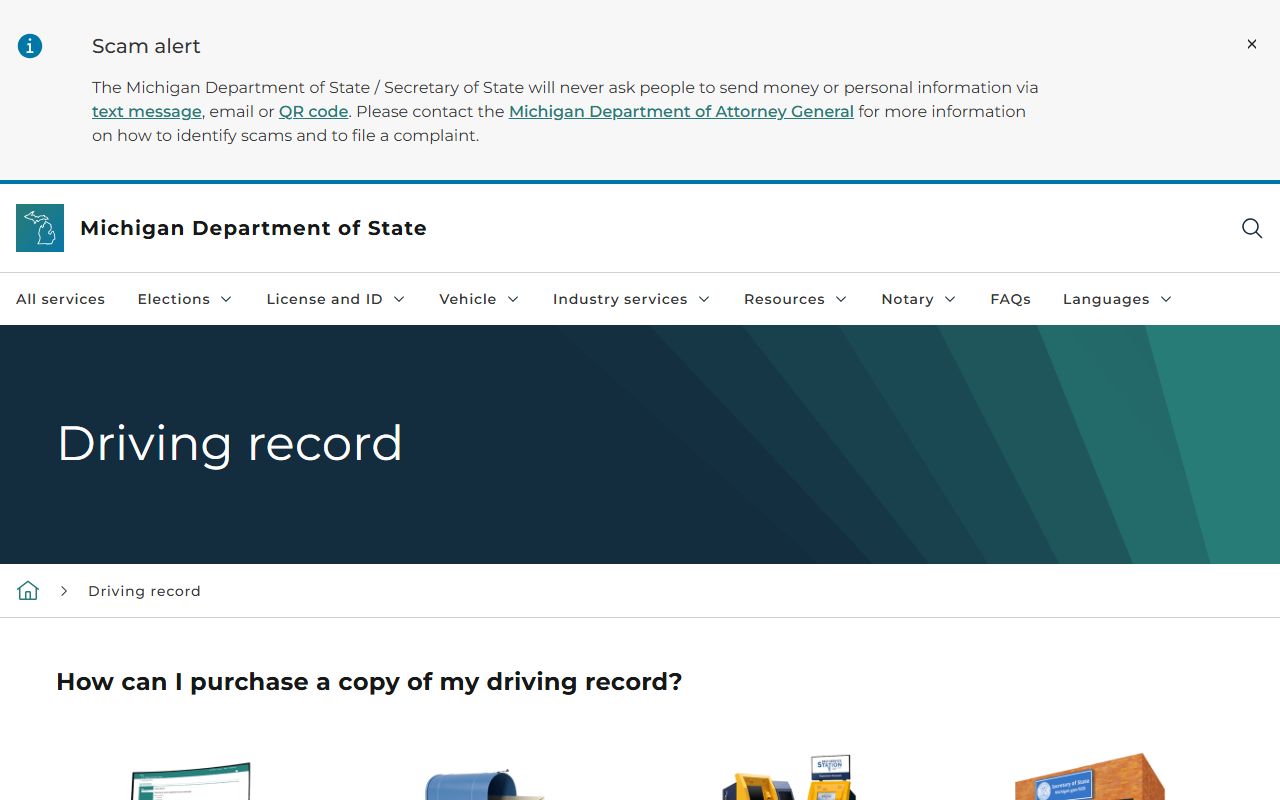
That state record reflects convictions, points, and suspensions pulled from courts statewide, while the Oceana County court file shows only the case the 79th District Court handled. Correcting an error means going to the right keeper: the court for a case entry, the Secretary of State for the driving record.
| Record Type | Keeper | What It Shows | How to Access |
|---|---|---|---|
| Court traffic case record | 79th District Court / MiCOURT | Citation, charge, hearing, responsibility finding, fine, court events, any default | MiCOURT, district court clerk, Court Display docket |
| Michigan driving record | Michigan Secretary of State | License status, reported convictions, points, suspensions and restrictions | SOS driving-record service, online or by official request |
| Criminal history | Michigan State Police ICHAT | Public criminal history for reportable felonies and serious misdemeanors | ICHAT; not a traffic file and no warrant data |
Commercial Drivers and CDL Traffic Records
A commercial driver's license holder runs a traffic case through the same 79th District Court as any other driver. The added risk sits on the state side. A conviction the court reports flows to the Secretary of State driving record, where points and license actions can weigh more heavily on a commercial license than on a standard one. For that reason a CDL holder often checks the state driving record after a case closes, not just the single court file.
Note: The court file confirms how a citation was resolved, but license and point consequences for a commercial driver appear on the state driving record maintained by the Secretary of State.
DUI and OWI Traffic Cases
Operating while intoxicated, called OWI in Michigan and often known as DUI or DWI, is a crime rather than a civil infraction. These cases start in the 79th District Court through arraignment and, for felony charges, bind over to the 51st Circuit Court. They are tracked as criminal cases, not routine traffic tickets.
For the full case file on an impaired-driving charge, including arraignment, plea, and sentence, see Oceana County criminal court records.
Setting Aside an Oceana County Traffic Conviction
Michigan uses the term set aside for clearing an eligible conviction from public access. A traffic offense has special treatment under MCL 780.621c, and the statute notes that an order setting aside a traffic offense does not necessarily remove it from the Secretary of State driving record. A set-aside can change public court access while the driving history keeps its own entry.
An application generally goes back to the court of conviction, which for Oceana County traffic matters is the 79th District Court. Court staff can provide forms and filing instructions, but under Michigan law clerks cannot give legal advice, so a driver weighing eligibility should confirm the current rules with the court or an attorney before filing.