
Oceana County Arrest Records and Court Charges
An Oceana County arrest record is the record of the arrest itself. It notes who was taken into custody, which agency made the arrest, and the booking that follows. In Oceana County most arrests are handled by the Sheriff's Office and the county jail in Hart. The county does not post a public jail roster on its own website, so current custody is confirmed through the statewide VINELink service or by calling the jail. A court charge record is a different thing. It begins when the Oceana County Prosecuting Attorney reviews the case and files formal charges with the court.
Put simply, the arrest is the police side and the charge is the court side. The booking detail, bond, and custody status sit with the jail, and those belong on the Oceana County inmate records page. The court charges after arrest are tracked through the case as it moves between the district and circuit courts. Charges can be added, changed, or dropped before a case ends. The final outcome and the sentence live in the full criminal court records.
The county Corrections Division runs the 66-bed jail where most local bookings happen, and its Corrections page outlines how the facility operates.
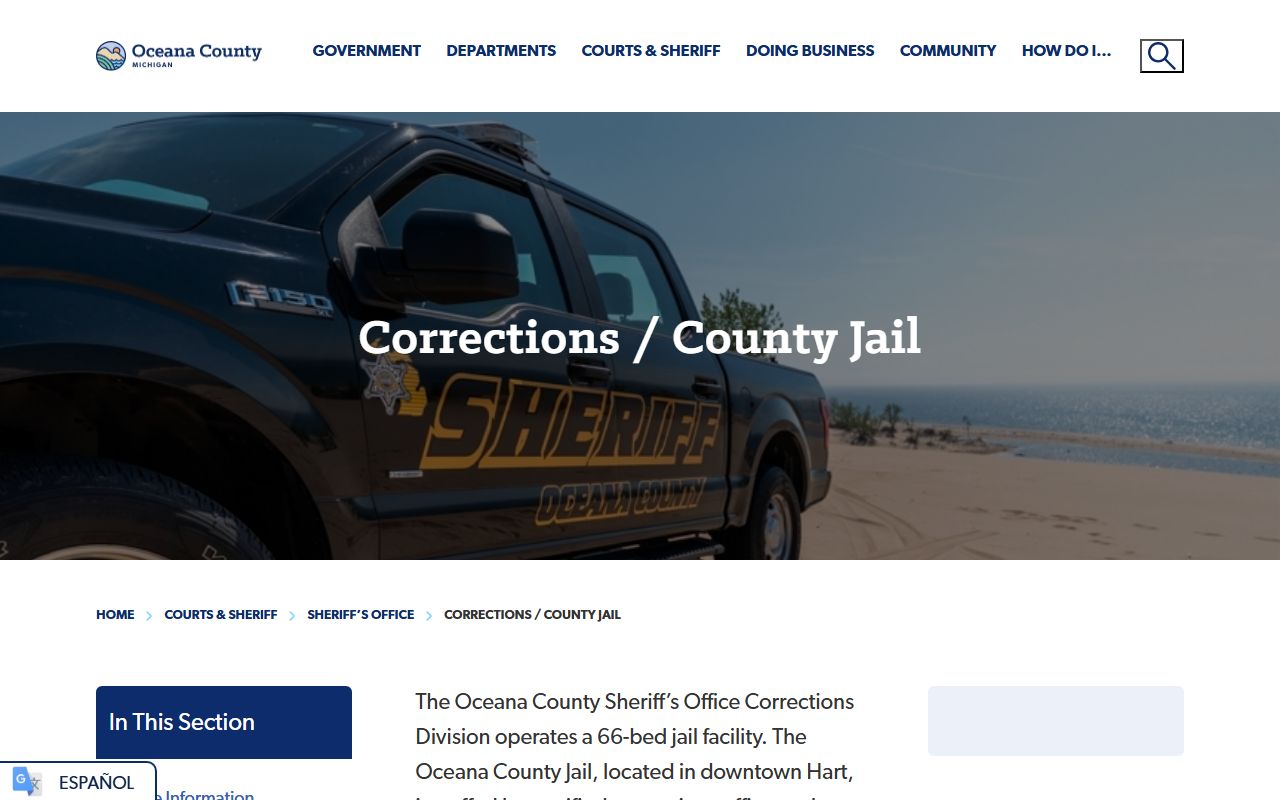
Because the booking side of an arrest starts at the jail, that facility is the first stop for custody status before any charges reach the court.
How to Find Oceana County Arrest Records and Charges
Charges and their current status show up in the Michigan judiciary's public case search. Oceana County links this tool from its court pages as the public case search. For a misdemeanor filed after arrest, the case sits with the 79th District Court. For a felony, the file moves to the 51st Circuit Court-Oceana County once a judge binds it over. Booking and custody detail are not in this court search. That information stays with the jail roster service.
- Open MiCOURT Case Search at micourt.courts.michigan.gov and choose the Oceana County court that fits the case.
- Search by the defendant's name, or by case number if it is known.
- Open the matching case and read the list of charges filed against the person.
- Check each charge for its statute code, its level, and its current status.
When the online view is thin, the two public Court Display dockets show the day's hearings for the district and circuit courts, and a written Circuit Court record search is available for five dollars per name by mail. A statewide criminal history summary comes from a separate State Police system rather than the county court file.
The county's inmate information page explains that current custody is checked through VINELink or by phone, not through a county roster.
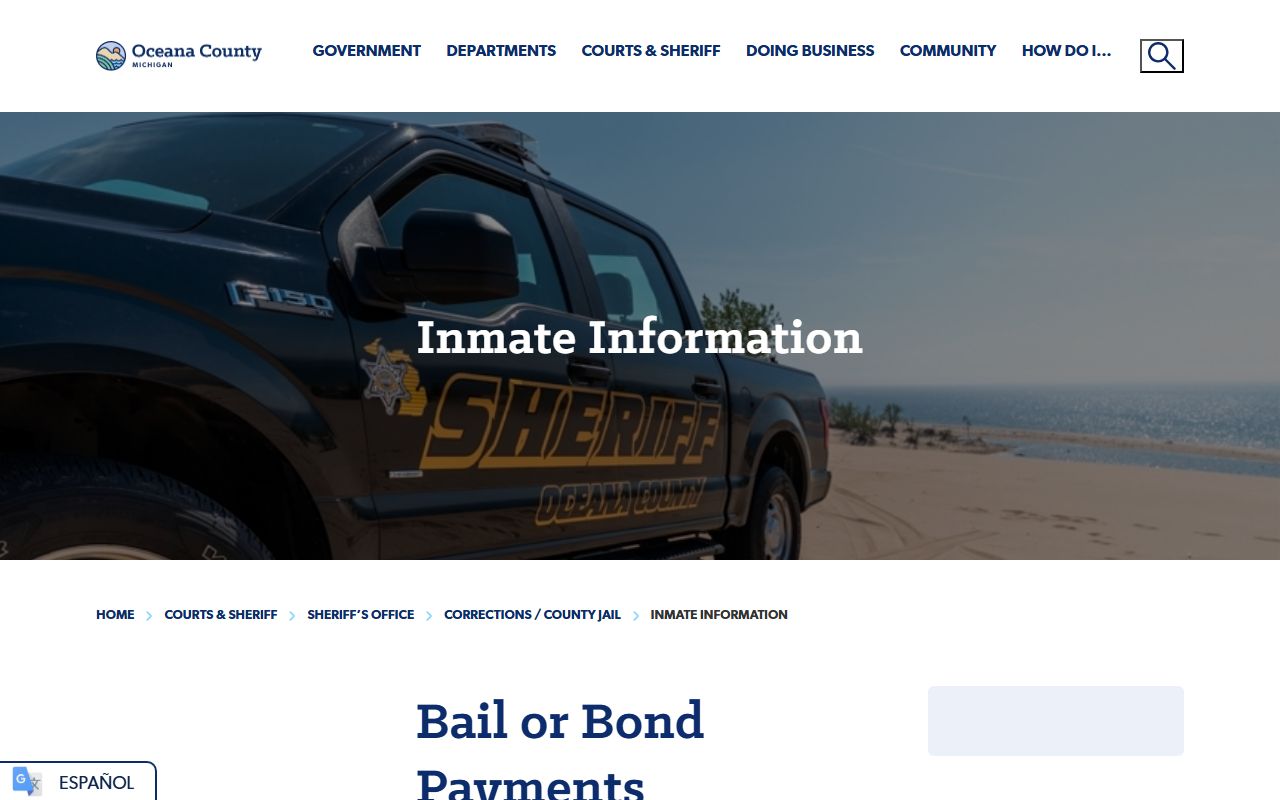
That custody lookup answers the arrest side, while the court search answers the charge side of the same case.
From Arrest to Arraignment in Oceana County
After an arrest, the first court step is usually an arraignment. In Oceana County, misdemeanor and early felony matters are arraigned at the 79th District Court. At arraignment the judge or magistrate reads the charge, advises the defendant of rights, takes an early plea, and sets bond. The District Court allows an arraignment by Zoom when a defendant requests it at least 48 hours ahead and tests the equipment first. A signed Advice of Rights can be returned by mail to the court's post office box or by email.
Bond set at arraignment can be posted online at any hour through the county's eXpress Account service, and a small fee applies. For a felony, the District Court also holds a preliminary examination to decide whether there is probable cause. If the judge finds enough evidence, the felony is bound over to the 51st Circuit Court, where the prosecutor files the next charging document. Misdemeanor charges stay in the District Court through plea or trial.
Note: An arraignment sets the early terms of a case, but the charge itself can still change as the prosecutor and the court review the evidence.
How Oceana County Charges Get Filed After an Arrest
The court charge record officially begins with a charging document. Which document is used depends on the offense level and the stage of the case. In Michigan, three main charging documents move a case forward, and Oceana County cases follow this pattern from the district court up to the circuit court.
Oceana County groups its trial courts and law enforcement together on one Courts and Sheriff hub, which links the district, circuit, and prosecutor pages that handle charges.
The prosecutor decides the charges, and the courts on that hub are where those charges are filed and heard.
| Complaint | Information | Indictment | |
|---|---|---|---|
| Filed By | Police officer or prosecutor | Prosecuting Attorney | Grand jury |
| Common For | Misdemeanors and start of felony cases | Felonies after bindover | Serious felonies |
| Where It Is Filed | 79th District Court | 51st Circuit Court | Circuit Court |
A complaint often starts a case at the district level. Once a felony passes the preliminary examination and is bound over, the prosecutor files an information in the circuit court. An indictment through a grand jury is the least common route in Michigan county practice.
Charge Codes and Severity Levels
Every charge ties back to a specific Michigan statute, and that statute sets the severity level. Oceana County charges fall into felonies, misdemeanors, and civil infractions. Felonies carry the longest possible penalties and belong in the 51st Circuit Court after bindover. Misdemeanors carry shorter jail terms and stay in the 79th District Court. Civil infractions, such as most traffic tickets, are not crimes at all and are handled as responsibility findings rather than convictions.
One arrest can produce several separate charges. A single incident might lead to a felony count, a misdemeanor count, and a civil infraction, each coded to its own statute and each carrying its own status. On a case search, the charges appear as a list, so counting them and reading each level gives a truer picture than the top charge alone.
Oceana County Charge Status and What It Means
Charges are not fixed once they are filed. As an Oceana County case moves, the prosecutor may amend a charge, reduce it, add a count, or drop it, and the court may dismiss one. Reading the status next to each charge tells you where that count stands right now.
| Status | What It Means |
|---|---|
| Pending | The charge is filed and the case is active while it moves through the court. |
| Amended / Reduced | The prosecutor changes the charge, often to a lower level, before or during the case. |
| Bound Over | A felony charge passes preliminary examination and transfers from district to circuit court. |
| Dismissed | The court drops the charge, and the case on that count ends without a conviction. |
| Nolle Prosequi | The prosecutor formally decides not to pursue the charge any further. |
A single case can hold several charges at once, each with its own status. One count may be dismissed while another moves to trial, so the status column matters more than the original charge list.
Statewide Charge and Criminal History Lookups
Charges and convictions from Oceana County also roll up into the state criminal-history system. The Michigan State Police run the Internet Criminal History Access Tool, known as ICHAT, a public name-based search that returns Michigan public conviction records for a set fee per search. ICHAT is a criminal-history summary, not the full court case file, and it does not show arrest warrants. The definitions behind that record system appear in MCL 28.241a.
For the full picture, ICHAT and the county court search work best together. ICHAT gives a statewide conviction summary across counties, while the Oceana County court search gives the charges, motions, and status inside a single local case. Neither one is a booking blotter, so custody detail still comes from the jail.
Charges vs. Convictions in Oceana County
Being charged is not the same as being convicted. A charge is an accusation that a prosecutor believes it can prove. A conviction is the result after a plea of guilty, a plea of no contest, or a verdict. Many Oceana County charges end in dismissal, reduction, or acquittal, so a charge alone should never be read as proof of guilt.
| Charge | Conviction | |
|---|---|---|
| Stage | Accusation | Verdict or plea |
| Burden of Proof | Probable cause | Beyond a reasonable doubt |
| Public Record | Yes, unless restricted | Yes, unless set aside |
Sealed vs. Set Aside Records in Oceana County
Michigan uses the term set aside rather than expunged. A set-aside removes an eligible conviction from public criminal-history access under MCL 780.621 and the state Clean Slate program, which clears some records automatically and others by application. Sealing instead hides a record from public view by court order for specific record types. Juvenile charges follow their own confidentiality rule under MCL 712A.28.
- Sealed record
- Hidden from public view by court order, though limited law-enforcement access can remain. Sealing is set by court rule for specific record types.
- Set aside record
- Removed from public criminal-history access, yet courts and police may still see certain records. A set-aside is granted automatically or by application, with waiting periods that depend on the conviction.
A set-aside does not mean every agency forgets the record. To clear an eligible Oceana County conviction, a person works with the court of conviction, since felony files route to the 51st Circuit Court and misdemeanor or traffic matters route to the 79th District Court.
Background Check Considerations
Formal background checks for jobs or housing follow the federal Fair Credit Reporting Act, while a casual name lookup does not. ICHAT and the county court file are public tools for personal information. They are not FCRA-regulated consumer reports, and they should not be treated as one.
Important: This website is not a consumer reporting agency under the Fair Credit Reporting Act, and its information cannot be used for employment, housing, credit, or other FCRA-regulated decisions.
Restricted Charge Records in Oceana County
Some charge records are not open to the public. Juvenile charges are confidential under state law, and set-aside convictions drop out of public access. Mental-health and adoption files carry their own restrictions. Dismissed charges may still appear in a case history, but they are not convictions and should not be read as one.
Online access is also narrower than in-person access. Michigan court rules, including MCR 1.109 and MCR 8.119, limit the public web view to case numbers, party names, and the register of actions. Full documents and sealed material may require a clerk visit or may not be available at all.
Note: A charge that has been dismissed or set aside can still surface in older indexes, so proof of the court order may be needed to correct a stale record.